Friday, January 7, 2011

1/6/11-Yunsu Y.

Today in class we went over our labs that we did for homework yesterday and they were collected. Then we continued our notes on hormones.

Hormone Notes Continued...

-Negative Feedback Mechanism (Estrogen):

  • this happens when levels of estrogen are low causing menstruation to occur. (FSH/LH released)
  • also, when levels of estrogen are too high, pituitary stops release of FSH/LH.

---when the egg is not fertilized the levels of these hormones fall.

BUT, when the egg is fertilized/pregnant: the levels of these hormones will stay consistent.

-IF the women is pregnant, the baby makes its own hormones, HCG (Human Chorionic Gonadotropin).

  • if this hormone is present, a urine test will usually tell you that you are pregnant.
  • the baby's hormone will get mixed into the mother's kidneys and will have HCG present in her urine.

-Results From Hormones:

  • Males: deeper voice. more facial hair and on body, chest broadens, larger muscles, and longer growth stage.
  • Females: Enlargement of breasts and reproductive organs, wider hips (for the baby), hair in armpits and pubic area, menstruation, and fat deposits under skin.

-----Then after notes we went over UP 15-18

-----then worked on Lab 9-14

HW: Finish Lab UP9-14, Stem Cell Reading and The Last Word worksheet, and STUDY for FINALS and also Unite TEST on THURSDAY 1/13/11!!

Next Scribe: Nick S.

Differences in male and female gametogenesis:

Females: Males:
ovaries testes
1 gamete parent cell 4 gamete parent cells
large,nonmotile, full of nutrients Small, motile few nutrients
oogenesis completed with sperm oogenesis completed before sperm is out of testes


Hormones & the Menstrual System:


4 hormones control menstrual system
  • Menstruation happens when Estrogen and progesterone are low
  • Progesterone causes lining of the uterus to thicken
  • When LH peaks it causes ovulation
  • Hypathalamus tells Auterior Pituitar to release LH
  • If 1 hormone does not work the system will not work
  • synchronize ovarian and menstrual cycles


Goal of female cycle: to get ready for fertilization(just in case)


4 Phases of Menstrual Cycle:

  1. Menstruation-about day 1-5, lining leaves the body
  2. Follicle-follicle matures
  3. Ovulation-day 14, mature egg released from ovary
  4. Luteal-development of the corpus luteum

Wednesday, January 5, 2011

1/5/10- Justin A.

Today we started off the day by going over UP page 4. For the rest of class we went through notes.

Human Reproduction
  • Both male and female have gonads. (organs that produce gametes). Males have testis and Females have ovaries.
Female Reproductive Anatomy
  • Ovaries- site of gamete production.
  • Follicles-Consists of single developing egg with tissue to nourish it.
  • Ovulation- When the egg is ejected from the follicle.
  • Corpus Luteum- The remaining follicle tissue after ovulation.
  • oviduct (fallopian tube)- Where fertilization takes place.
  • Uterus- site of pregnancy. Has muscle to expand to accommodate the fetus.
  • Endometrium- Layer of tissue that lines the uterus. Site where embryo implants itself.
  • embryo- from zygote to 9 weeks.
  • fetus- 9 weeks to birth.
  • cervix- neck at bottom of uterus
  • vagina-(birth canal) where sperm is deposited.
  • urethra- Tube for urine.
  • Labia Minora- skin around opening to vagina.
  • Labia majora- skin around genetil region.
  • Hymen- thin membrane partially covering vagina.
Male Reproductive Anatomy

  • Penis- Contains erectile tissue. Shaft that supports glans.
  • Testes- male gonads located outer body in scrotum.
  • scrtotum- sac that holds testes away from body.
  • epididymis- stores sperm
  • ejaculation- expulsion of sperm containg fluids from penis.
  • Pathway of sperm during Ejaculation.
  1. Leave epididymis.
  2. Vas deferen -duct
  3. seminal vesical and prostate gland.
  4. Empties into urethra
  5. semen- 95% fluid from glands and 5% sperm cells.

Gametogenesis- (production of gametes)
  • gametes are haploid ccells developed in meiosis.
Female Gametogenesis
  • oogenesis- developement of eggs with the ovaries.
  • At birth each follicle contians 1 dormant primary oocyte. (diploid cell)
  • FSH (Follicle Stimulating Hormone) trigger further developement of follicles.
  • Follicle enlarges and oocyte completes meiosis
  • Secondary oocyte recieves almost all of cytoplasm. Other degenerates.
  • IF sperm fuses with secondary oocyte, it will complete meiosis 2.
Male Gametogenesis
  • spermatogenesis- formation of sperm cells.
  • Some cells go under mitosis while the others go through meiosis.
  • four spermatids are produced after meiosis 2.
  • Spermatids are immature to sperm.
Homework:Pre lab 35-38,

Next scribe : Carey E.

Monday, January 3, 2011

1/3/11

1/3/11- Today, we began a new unit: reproduction. The main concept that we learned was the main differences between external and internal fertilization and external and internal development. We also completed the first 3 pages of notes, which can be found on Mrs. Andrew's moodle page.
So, the main differences between external and internal fertilization is the fact that external fertilization involves the union of gametes outside the body and usually involves water-type environments. Internal fertilization, however, involves the union of gametes inside the body and is most common in terrestrial animals.
In addition, the main differences between internal and external development is the fact that external development involves growth of offspring outside the body, and internal development involves growth of offspring inside the parent's body.
Besides the types of fertilization and development, we also discussed the two types of reproducing organisms: sexual and asexual. Sexually reproducing animals reproduce via the fertilization of sperm (from a male parent) and egg (from a female parent). An asexually reproducing organism is one who literally "clones" itself, because of the fact that they would reproduce without the fertilization process.


Justin A. is the next scribe poster.

Friday, December 10, 2010

12/9/10

today we learned how restriction enzymes cut DNA into fragments. Gel electrophore sorts macromolecules by charge and length. DNA fragments have a negative charge and move toward the positive pole smaller fragments move faster than larger ones

Wednesday, December 8, 2010

8.12.10

Kristen
Genetic Engineering Notes

Today in class we started our notes on Unit 5: "Designer Genes"
Notes:

DNA Technology- methods to study and manipulate genetic material.
ex:
  • corn can produce its own insecticid
  • Bacteria can clean up pollution
  • DNA fingerprints- to solve crimes
  • Advances toward curing fatal genetic diseases
4 Ways DNA technology Can Be Used:
  • Use of recombinant (recombine) to produce useful products
  • Use of DNA fingerprinting in forensic science
  • Comparison of genomes
  • Use of human gene therapy for treatment of diseases
3 Ways to Transfer DNA

1. Transformation- the taking up of DNA from the fluid surrounding a cell.


2. Transduction- the transfer of bacterial genes by a phage. The phage has a fragment of
DNA from its previous host cell. Now it is injected into the new host.


3. Conjugation- a "male" bacterial cell attaches to a "female"v cell by sex pili, a bridge forms, and DNA passes from the male to the female.


Here are some terms we went over today:

Biotechnology- the use of organisms to perform practical tasks.

ex: use of bacteria to produce cancer drugs and pesticides

Genetically Modified organism- an organism that carries recombinant DNA

Transgenic organism- a host that carries DNA from a different species

Cutting and Pasting DNA:

  • Restriction Enzymes- the cutting tools. These enzymes recognize short nucleotide sequences in DNA and cut at specific points.
  • Restriction site- the place where DNA is cut
  • staggered cuts yield 2 double stranded DNA fragments with single stranded "sticky ends"
  • Sticky ends are key to joining with other DNA
  • Join another DNA with 1st DNA
  • DNA ligase connects the DNA pieces
  • Result: a DNA recombinant molecule from 2 different sources


Obtaining the gene of interest: 2 ways

1. Using a radioactive DNA probe
2. Use reverse transcription to make an artificial DNA gene from mRNA

DNA Fingerprinting- a procedure that analyzes a person's unique collection of DNA restriction fragments. Used in forensics- determines whether 2 samples of DNA are from the same individual. Samples come from blood, semen,hair, skin or other biological evidence.


Homework: UP pg. 13-15, 7-10, 5-6


Next scribe: Davin

Wednesday, December 1, 2010

December 1, 2010

Scribe: Katie
Agenda


  • Notes
  • Lab 37 work
Notes
- Review:
  • DNA --> RNA -->Protein
  • Genes determine protein which makes up your appearance and cell capabilities
-Mutations:
  • Change in nucleotide sequence of DNA:
a. Base substitutions -replacement of one base for another. Can result in no change, critical, bad or good.
b. Base insertions or deletions - adding or subtracting nucleotides. Often results in disaster- can disrupt entire sequence of triplet pairings.
  • Mutagens - physical and chemical agents, such as UV light, X Rays, chemicals, carcinogens. These CAN cause mutations. They can also lead to diversity. DNA errors can also be due to unknown causes.


Lab info.


  • DNA has two strands, one will have a base sequence.
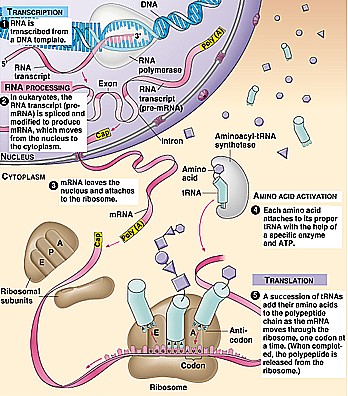
  • In the process of transcription, a strand of messenger RNA is transcribed with a sequence complimentary to the base sequence of the DNA. (this happens in the nucleus, DNA does not leave the nucleus, RNA does) **Remember RNA has U instead of T-- Uracil instead of Thymine**
  • During translation, codons, or sequences of nucleotides, form a code that specifies the order that amino acids, the "building blocks of protein", should be linked in a protein. Transfer RNA bring amino acids into place to be linked together with the according codons. In this process. the code in the messenger RNA, is translated into a special sequence of amino acids.(This all takes place attached on a ribosome in the cytoplasm)
  • When the ribosome is attached to the messenger RNA, transfer RNA carrying it's specific amino acid molecule, temporarily attached to the messenger RNA at its codon. Then, a transfer RNA molecule complimentary to the adjacent messenger RNA temporarily attaches to it. The ribosome then moves to that point of attachment on the messenger RNA. During each of those attachments, peptide bonds formed between the amino acids. And the transfer RNA molecules become free from the amino acids and RNA, and they can attach to another molecule of it's specific amino acid and carry it to another point along the messenger RNA. This is a growing chain that continues as ribosomes move along messenger RNA, as amino acids are added.
  • This pattern does not end until a termination codon is encountored. This gives the code for the translation to stop.

Homework


  • Finish lab 37
  • Do UP pages 99-110
  • Work on Tribune project (Due: 12/7)

NEXT SCRIBE: Kristen