Showing posts with label Bridget. Show all posts

Saturday, April 9, 2011

4/8/11

Photosynthesis Chemical Reaction (Please Memorize!!!!)
  • 6 CO2 + 6 H20 = C6H1206 + 6 O2
  • (The numbers are actually subscripts and the "equals" sign is actually an arrow, meaning "yield")
  • Reactants= 6 CO2 (Carbon Dioxide), 6 H20 (Water)
  • Products= C6H1206 (Glucose), 6 02 (Oxygen Gas)
  • Electrons added to Carbon dioxide to produce sugar Water molecules split and release oxygen gas (Sunlight provides the energy for this)
  • Simple Summary of Photosynthesis


Light Reactions and Calvin Cycle- 2 different cycles but work together

  • Light Reactions
  • convert solar energy to chemical energy
  • make ATP (for energy storage) and NADPH (is an electron carrier)
  • Reactants: NADP+ and ADP and Water (H20) and Light
  • Products: Oxygen and ATP and NADPH
  • Happens in thylakoid
  • Calvin Cycle
  • "light independent cycle" or "dark reactions"
  • makes sugar from CO2
  • uses ATP and NADPH from light reactions
  • Reactants: CO2, ATP, NADPH
  • Products: Sugar (there are other products too; any other organic product can result also)

Products of Light Reactions are needed for Calvin Cycle and products of Calvin Cycle needed for Light Reactions (Dependent on each other)

Light Reactions

(More Detailed)

  • Light is energy!!!
  • Sunlight- radiation or electromagnetic energy
  • Visible Light is from 380-750 nm (wavelength)
  • What we can see- ONLY light reflected from an object

EX- green leaves absorb red-orange and blue-violet light; reflecting green light (chloroplasts convert that absorbed energy into chemical energy)


  • Chloroplast Pigments (found in photosystems)
  • Chlorophyll a-
  • absorbs blue-violet light and red light
  • participates directly w/ light reactions
  • Chloropyll b-
  • absorbs blue and orange light
  • increases range of light that can be absorbed (helps light reactions)
  • Carotenoids-
  • absorbs blue-green light
  • absorbs and dissipates excessive light that could damage chlorophyll a

Photosystems and Light

  • Photon- fixed quantity of light energy
  • pigment molecules absorb photons of light, "exciting" the electrons so that they have more energy (higher energy state)
  • electrons "falls" back to normal state (because the more energy they have the more unstable they are)
  • releases energy (in form of light or heat)


arrows=light and heat energy being released as electron falls back to normal state


    • Photosystems- have clusters of pigment molecules that act as antennae for photons of light
    • Photons of light "jump" from pigment to pigment until they reach the Reaction Center (has chlorophyll a)
    • Next to Reaction Center= Primary Electron Acceptor
    • traps the excited light energy into ATP or NADPH


    2 types of Photosystems

    • Water-splitting
    • light energy to extract electrons from water
    • releases oxygen as waste product
    • NADPH Producing
    • produces NADPH by transferring light excited electrons from chlorophyll to NADP+
    • ALL ENERGY IS STORED IN CHEMICAL BONDS!!!!
    • Electron transport chain
    • connects the 2 photosystems, releases energy used to make ATP


    • ATP Synthase- uses energy stored by H+ gradient to make ATP
    • H+ molecules= more on the inside than on the outside, so they want to move to the outside


    HW:

    Read CH. 7

    Pre-lab UP pg. 9-12

    Next scribe= Kristen :):)

    Wednesday, February 9, 2011

    2/9/11

    Today, we took a quiz.
    Notes:

    Human Ancestry

    • Early primates:

      evolved from insect-eating mammals during Cretaceous period (evidence from fossils)

    • were small

    • lived in trees (arboreal)

    • limber shoulder joints

    • could grab with their hands (dexterous)

    • nails started replacing claws

    • had depth perception (eyes close together in front of face)

    • eye-hand coordination

    • parents cared for their offspring


    The 2 Major Primate Groups:

    Prosimians

    • oldest

    • EX- lemurs, lorises, pottos, tarsiers
    Anthropoids

    • EX-monkeys, apes, humans

    • New World monkeys

    • in the Americas

    • arboreal

    • prehensile tails-could swing by tails and grab things with them unlike dogs or cats, it functioned as an extra appendage

    • Old World monkeys

    • mostly ground dwellers

    • EX- baboons-

    • -Prehensile tail, New World

    Human Ancestors

    • closest anthropoid relatives=apes
    • gibbons, orangutans, gorillas, chimps
    • apes today live in tropical regions of Old World
    • Humans
    • young twig on vertebrate branch
    • chimps and humans diverged from common ancestor 5-7 million yrs. ago

    • Our ancestors are not modern apes and chimps; we diverged on a different branch than they did, but we both evolved from a common ancestor
    • they are more like our cousins than anything else

    • Human evolution is not a series of steps leading directly from an anthropoid ancestor to Homo sapiens; other groups have traveled to dead ends and died off
    • Many different human species coexisted
    • We are a subspecies of Homo sapiens

    • Human characteristics did not evolve at the same time
    • They evolved at different rates
    • Bipedalism-walking on two feet, led the way
    • We had some ancestors who walked on two feet and upright, but they still had ape-sized brains

    Kinds of Hominids

    Australopithecus-walked African savanna, came before Homo genus:

    • A. afarensis
    • early species
    • bipedal
    • a skull was found that was about 3.9 million yrs. old. It had a vertical backbone which provided evidence that upright posture is at least that old
    • Lucy-very complete skeleton of A. afarensis, female, 3ft tall, 3.2 million yrs. old
    • footprints also found, bipedal footprints in Africa, 3.7 million yrs. old
    • bipedalism is a very old trait
    • Australopithecus went extinct about 1.4 million yrs. ago

    Homework!!

    Lab 32-due Monday

    Up pgs. 69-70, read and questions

    Next scribe:

    Aliza!! :)

    Tuesday, November 30, 2010

    Transcription and Translation

    Bridget 11/30/10


    • A chart for reading genetic codes.... know how to read this for the test
    • find first letter in center of circle
    • find second letter in the 2nd row
    • find third letter in 3rd row
    • 61 codes for amino acids- 3 of them, UAA, UAG, and UGA tell the ribosomes to stop making the polypeptide
    • AUG= Methionine but also provides signal to start a polypeptide chain
    • Most codes are shared by all organisms
    DNA Replication
    • making exact copies of DNA in nucleus, occurs before cell division(mitosis/meiosis
      enzyme= DNA polymerase

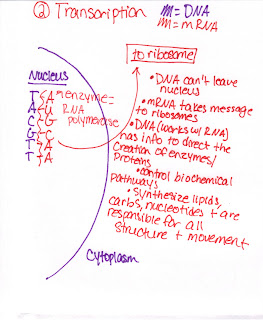
    Transcription
    • molecule of DNA is copied into a complementary strand of mRNA
      enzyme=RNA polymerase

    Steps of Transcription:

    1. Initiation- RNA polymerase attaches to the DNA promoter nucleotide sequence on DNA, RNA is made
    2. RNA elongation- RNA grows longer, peels away from DNA, DNA strands come back together
    3. Termination-RNA polymerase reaches the end of the gene (the terminator), polymerase molecule detaches from RNA molecule and the gene
    Processing RNA:
    • Prokaryotes- the mRNA is already ready
    • Eukaryotes- need to proccess, add extra nucleotides
    • cap and tail-protect RNA from enzymes, help ribosomes recognize it as mRNA
    • introns- bad, noncoding regions
    • exons- good, cooding regions
    • RNA splicing- introns removed before RNA leaves nucleus
    • Now mRNA is ready!!!!
    Translation
    • mRNA (Messenger RNA) translated into tRNA (Transfer RNA)
    • mRNA goes to ribosome
    • 2 subunits made of proteins and rRNA (ribosomal RNA)
    • small subunit- binding site for mRNA
    • large subunit- binding site for tRNA
    • tRNA-twists and folds, end of folded molecule=anticodon
    • anticodon recognizes codon on mRNA, then the other end of the tRNA is where an amino acid can attach
    • Bonds between (AA)s ((amino acids)) are peptide bonds
    • The polypeptide that is growing and forming is the protein!!


    Steps of Translation:
    1. Initiation- mRNA binds to small ribosomal subunit, tRNA attached to amino acid binds to start codon, AUG on mRNA; large ribosomal subunit binds to small one, which creates a working ribosome
    2. Elongation- amino acids are added to the first amino acid, creating a polypeptide chain
    3. Termination- one of the stop codons tells the translation to stop. Polypeptide is freed ( many A.A), and ribosome splits into its subunits
    RNA has:
    • Ribose sugar
    • 1 strand
    • U instead of T
    • smaller than DNA, can go inside/outside nucleus
    • 3 types: mRNA, tRNA, rRNA
    Next scribe: Katie!! :)
    Homework:
    • UP 99-110 due 12/2
    • Pre-lab 37- cut out????
    • DNA/ Chicago Tribune Project Due next Tues.

    Wednesday, October 27, 2010

    October 27, 2010, B-Cells and T-Cells

    Today, we watched two short movie clips.

    One was about the role of an antibody.


    • neutralization
    • aggulination
    • precipitation
    • complement proteins
    The other was about:
    • humoral immunity- provided by B-cells, defends primarily vs. bacteria and viruses present in body fluids
    • clonal selection
    Notes: Page 21, 23, 24
    Clonal Selection
    • When an antigen enters the body fluids, it binds with B-Cells that have complementary receptors
    • The B-cells are then activated; they grow and divide, creating effector cells
    • These cells then secrete antibodies specific to that antigen
    • plasma cells- make the antibodies
    • memory cells- "remember," this is why you don't get the same exact infection again because your body produced the antibodies needed to fight that infection
    T-Cells
    • Cell-mediated immunity
    • Respond to antigens that have already entered the body
    • More "hands on" than B-Cells
    • 3 kinds- Helper T-Cells, Cytotoxic T-Cells, and Supressor T-Cells
    Helper T-Cells
    • Macrophages engulf a microbe, produce antigens, and displays the foreign antigens on the cell membrane
    • it is essentially saying "I found something and I don't think it's good!"
    • The Helper T-Cell binds to the macrophage at the site and determines if it is good or bad
    • If bad, the Helper T-Cell divides, produces memory cells, and stimulates activity of cytotoxic T-Cells
    Cytotoxic T-Cells (Killer T-Cells)
    • Identifies infected body cells and binds to them
    • Discharges perforin which is a protein that creates a hole in the infected cell's membrane, causing it to die.
    • This needs to happen because the infected cell has become a factory of pathogens and the body needs to have it shut down.
    Homework:
    • UP pgs. 47 and 57
    • UP pg. 5 What is Ecology Good For (E.C.)
    • Work on Lab Report, Due: 11/8
    • The Test may be on Tuesday, but please still plan on Friday!!!
    Next Scribe:
    • Claire T

    Wednesday, September 1, 2010

    Aug 31, 2010

    Scribe - Bridget S.

    Agenda for Today

    • Finished Lab 1- Microscope
    • Talked about “Ecology of an Oil Spill” writing assignment- DUE 9/22/10
    • Started ecology notes Ch. 18

    The Microscope Lab Summary

    • This lab was to help you get used to using a microscope.
    • First, we put a small letter “e” clipped from a newspaper onto a slide, dropped a drop of water onto it, and placed the cover slip on top. (this is called a wet mount.)
    • Then, we looked at the “e” from the microscope, adjusting the coarse focus knob until it came into focus. (your field of view.)
    • We examined what happened when the slide was moved to the left and when it was moved to the right.
    • We also examined the “e” under different powers and recorded what it looked like.
    • Then, we prepared a wet mount with 2 pieces of crossing hair and examined them under different powers.

    **Why did we do this lab? - to understand 1.  field of view, 2. depth and resolving power, 3. how to increase magnification without losing your object, 4. familiarize yourself with how to use the microscope


     Please answer questions on page 34. (UP)

    “Ecology of an Oil Spill” Assignment- DUE 9/22/10

    • Please read pgs. 5-7. (UP)

    o You have been hired by BP to write a paper suggesting 3 ideas (and their approximate cost for each) for solving the oil spill problem and to help save the lives of marine organisms. (plants and animals)
    o You need to research the effects an oil spill has on plants and animals first.
    o Your paper should include the following;

     A cover sheet
     Intro paragraph
     Body
     Conclusion
     Bibliography

    • Here are some additional things we went over in class:

     “Wikipedia “ is NOT a source
     Use in-text citations (Author, pg. #) after every sentence that is not yours
     Do not use contractions
     Be sure to write in 3rd person, no “I”
     If you use the websites on pg. 6, still cite them correctly
     Use the MLA FORMAT TO CITE
     You may use the article on pg. 8A to get you started

    Ch. 18 Notes so far

    Pgs. 1-2

    • Population is increasing rapidly, so we have to be careful to not lose all of the resources that we have.
    • We learned new terms about ecology like;
     Ecology- interactions between organisms and their environment
     Abiotic factors- non- living chemical and physical factors
     Biotic factors- living factors
     Population- group of individuals of the same species living in a particular area
     Community- all the organisms inhabiting a particular area
     Ecosystem – the community and abiotic factors
     Biosphere- sum of earth’s ecosystems
     Environmentalism – started in the 1960s when people realized that unsafe technology was being practiced in the 1950s

    Homework

    • Start oil spill research
    • Read textbook Ch. 18 and do notes (in Moodle)
    • Finish Lab #1
    • Termite Lab report due 9/10

    Next scribe = Aliza